 Tiếng Việt
Tiếng Việt
Tiếng Việt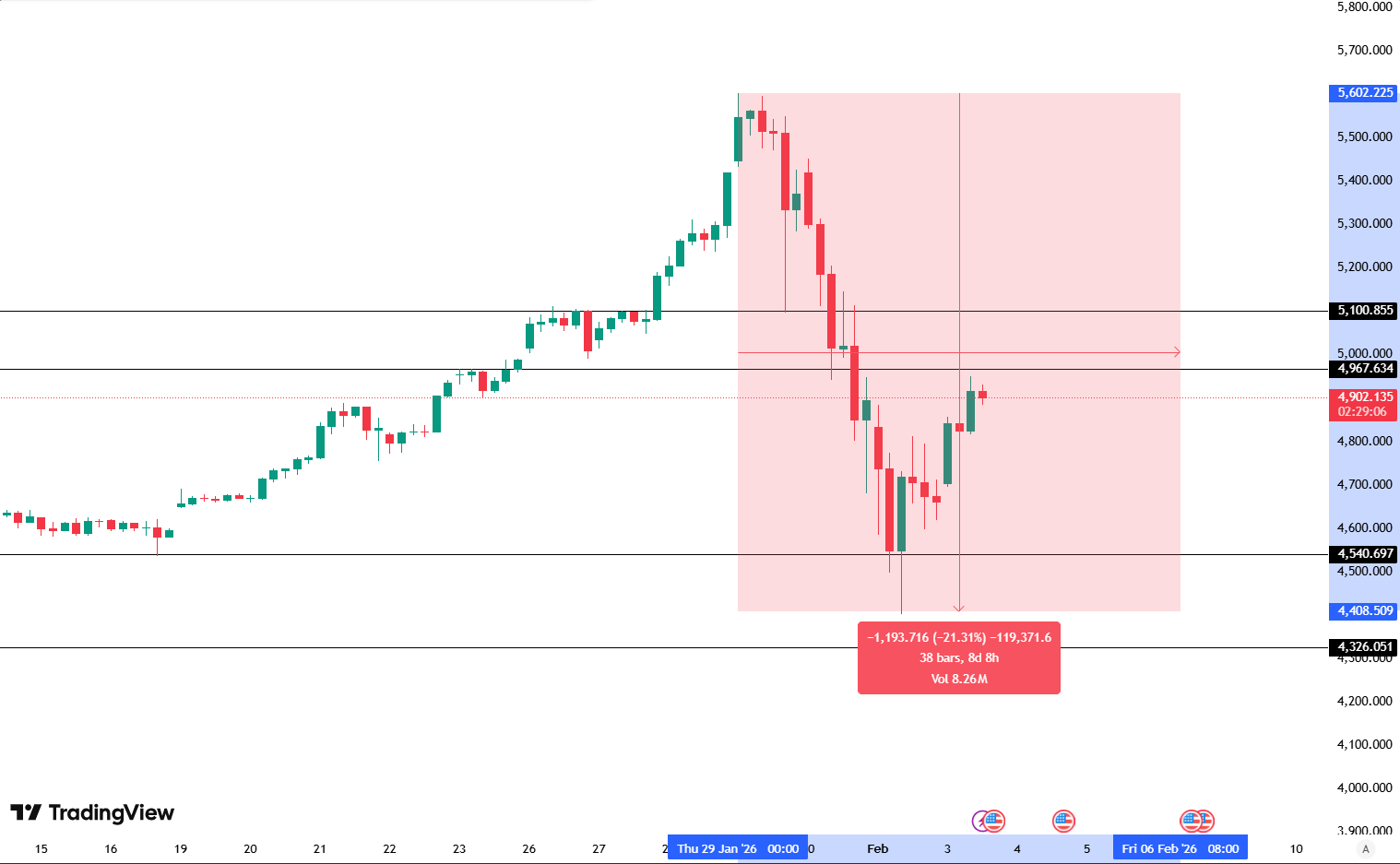
After reaching historic highs above the $5,600 region, gold experienced a sharp correction of approximately 21.30%, shedding more than $1,190 from peak to trough within a relatively short period. The move marked one of the deepest pullbacks seen during the current long-term bullish cycle.
While the broader trend remains structurally intact, the magnitude and speed of the decline raised important questions around positioning, sentiment, and risk management.
The correction was not the result of a single factor, but rather a confluence of macro, technical, and positioning dynamics.
Gold’s rally into record highs was aggressive and largely vertical, leaving the market technically overextended. Such moves often attract:
Heavy profit-taking from institutional players
Short-term speculative exits
Reduced marginal buying interest at elevated levels
Once momentum slowed, selling pressure accelerated quickly.
Despite broader structural weakness in the U.S. dollar, short-term stabilization in the dollar and U.S. yields created a counter-trend environment:
Real yields stopped falling temporarily
Safe-haven demand eased
Capital rotated into cash and defensive dollar exposure
This shift reduced gold’s immediate appeal.
Data from price behavior and volume suggests that long positioning had become crowded near the highs. When sentiment flips in such environments:
Stop-loss cascades intensify declines
Liquidity pockets get exploited
Corrections tend to overshoot fair value
The result was a rapid downside extension.
From a chart perspective:
Gold failed to sustain acceptance above the $5,500–$5,600 region
A clear distribution phase emerged before the breakdown
Once key support levels failed, price moved swiftly toward major liquidity zones
This reinforced the speed of the sell-off.
Despite the size of the decline, price action still suggests a corrective move within a broader bullish structure, rather than a full trend reversal.
Key observations:
Price reacted strongly near higher-timeframe support zones
No long-term trendline invalidation occurred
The decline resembles a classic impulse-correction sequence
As long as gold holds above major structural supports, the long-term bullish bias remains technically valid.
Even the strongest trends require deep corrections to:
Reset sentiment
Rebuild liquidity
Create sustainable continuation
Corrections are not failures — they are structural necessities.
Parabolic price action often looks strongest near the top. Historically, these phases:
Reward late buyers the least
Punish poor risk management
Reverse faster than expected
Patience always outperforms chasing.
Markets move where liquidity is concentrated. The drop into lower zones was not random — it was liquidity-driven, clearing weak hands before stability returned.
The gold correction reinforced one timeless rule:
Direction matters, but risk management decides survival.
Even correct long-term bias fails without disciplined position sizing and exit planning.
If gold stabilizes above its key higher-timeframe support zones, the market may:
Enter a consolidation phase
Rebuild bullish structure
Prepare for another directional move later in the cycle
However, sustained weakness below structural levels would signal a deeper corrective phase.
Gold’s 21.3% pullback from historic highs was sharp, emotional, and technically significant — but not abnormal. The move served as a powerful reminder that markets reward discipline, not emotion, and that even safe-haven assets demand respect for structure, liquidity, and risk.
Understanding corrections is just as important as identifying trends.
Bởi Motasm Adel
Nghiên cứu thị trường và Nhà phân tích
Tuyên bố miễn trừ trách nhiệm về rủi ro: Thông tin này chỉ dành cho mục đích giáo dục và không cấu thành lời khuyên đầu tư. Thị trường tài chính tiềm ẩn nhiều rủi ro và kết quả trong quá khứ không phản ánh kết quả trong tương lai. Luôn tự nghiên cứu và tìm kiếm lời khuyên chuyên nghiệp trước khi đưa ra quyết định đầu tư.